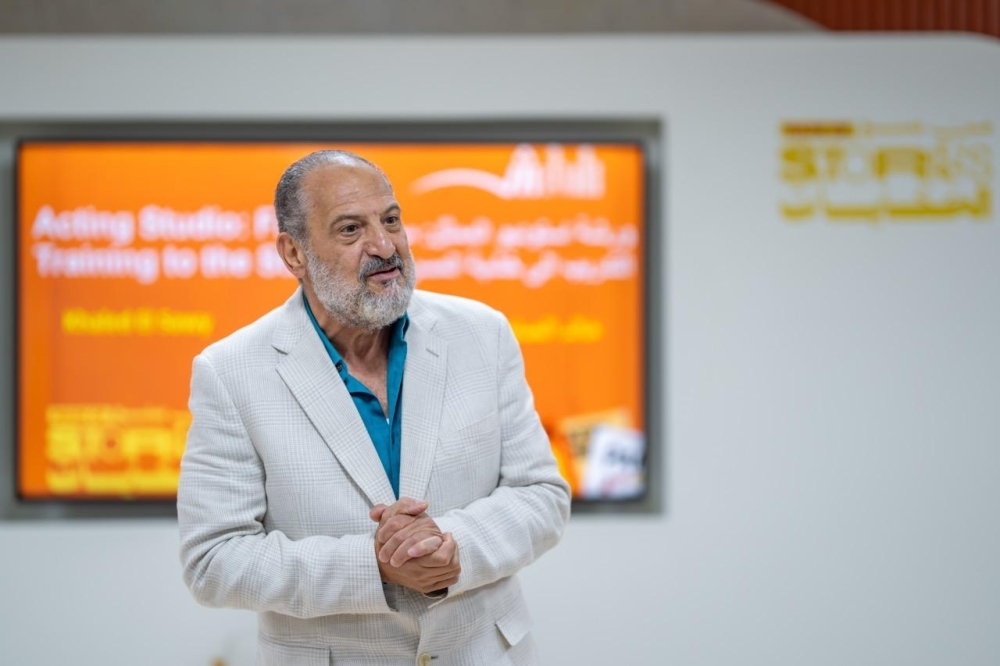


Talent alone is not enough to command an audience, Egyptian actor Khaled El Sawy told participants at the Sharjah International Book Fair 2026, highlighting the training, confidence and control of voice and movement needed for effective performance.
Leading a workshop titled “Acting studio from training to the stage”, El Sawy drew on his acting and training experiences to explore how performers build stage presence, overcome fear and connect with everyone in the audience.
He recalled a young man whose smart appearance and athletic build were undermined by a series of mistakes on stage. Keeping one hand in his trouser pocket, he held the microphone inconsistently, causing his voice level to fluctuate. His hand trembled, and he addressed one section of the audience while neglecting the rest.
The greater problem, El Sawy said, was the young man’s reluctance to accept feedback. He explained that his own advice to aspiring performers came from mistakes he had made and learned from throughout his career.
Every gesture matters when facing an audience, he noted, because viewers’ attention is directed towards the person on stage, making movement and posture part of the message.
Exploring what he described as the “geography of the actor”, El Sawy examined the boundaries of acting and its connections with other professions. Teachers, lawyers, broadcasters, preachers and presenters, he suggested, draw on some of the same skills used by actors.
A lawyer speaking in the first person on behalf of a client, for example, illustrates how representing another person’s perspective can extend beyond the theatre.
El Sawy also discussed voice acting and the importance of school theatre in developing skills and building character. Acting, he explained, requires performers to understand and inhabit a role rather than simply present their everyday selves.
He described the relationship between actor and audience as a “beautiful lie”: viewers know they are watching an imagined character, yet willingly enter that character’s world and respond to its experiences and emotions.
Voice was central to the practical exercises. Asking participants to speak more audibly and clearly, El Sawy explained that vocal projection does not come from shouting or straining the throat. It requires training, an understanding of the body’s capabilities and control over how the voice is used and directed.
Such skills, he added, are valuable beyond acting, particularly in broadcasting, education, content creation and other fields that involve addressing an audience.
Concentration was another focus. Performers must be able to recover from interruptions, regain their attention and resume without losing the thread of their thoughts, he said.
El Sawy also emphasised the expressive value of silence. Pauses, movement and body language can communicate meaning as effectively as words, without the need for continuous speech.
Drawing on examples from cinema, including Charlie Chaplin’s Tramp, he illustrated how movement and physical expression can create a memorable character. Through discussion and practical interaction, the workshop presented acting as a craft shaped by observation, understanding, experimentation and discipline.
Oman Observer is now on the WhatsApp channel. Click here